What it does
These are the parts that work today, in early access. The pictures are of the system itself, filled with an invented tribunal and invented causes.
The docket
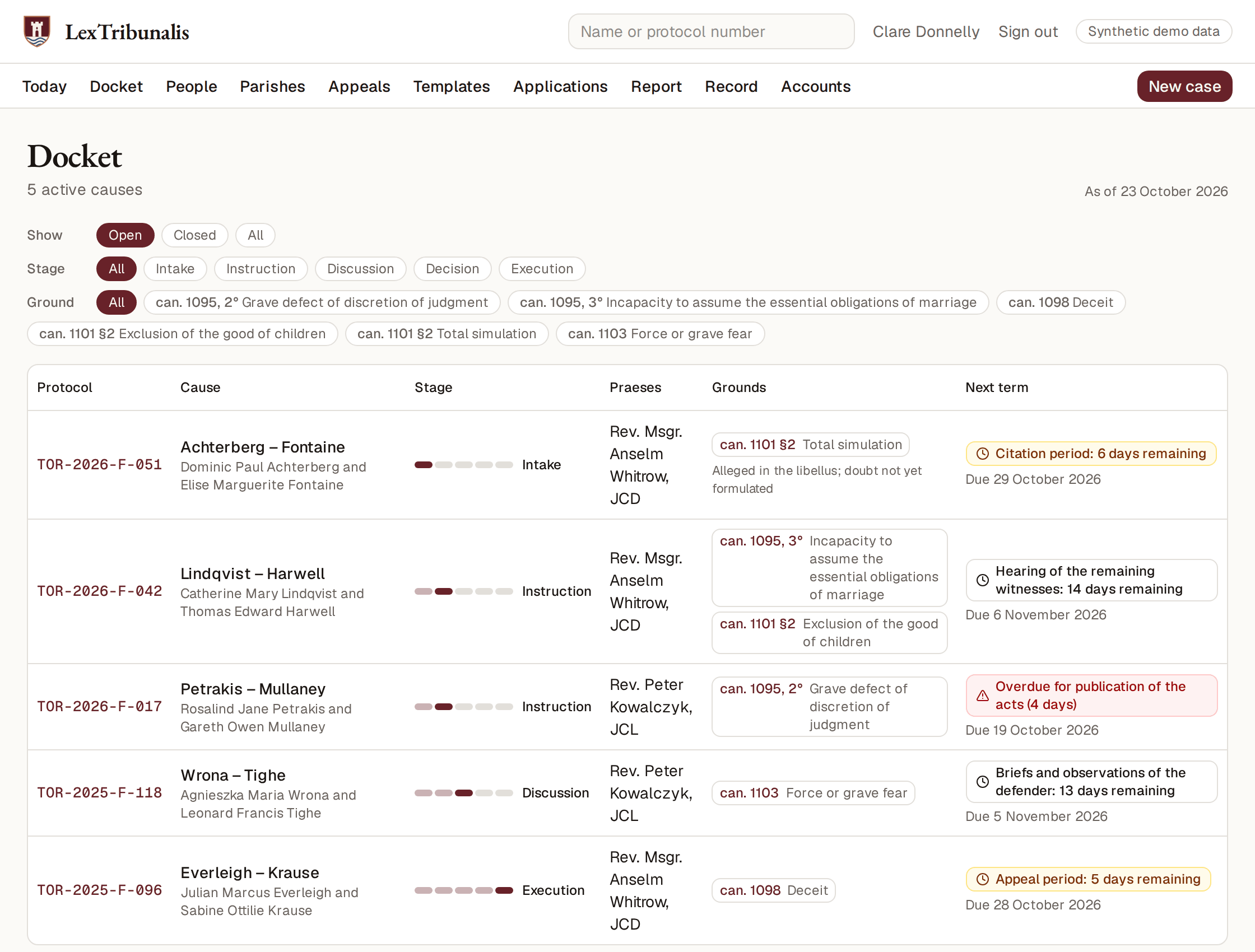
Every active cause on one page, with its protocol number, the stage it has reached, the praeses, the grounds and its most pressing time limit.
The list can be narrowed by stage or by ground, and closed causes are shown when asked for. A search box finds a person by any of their names, or a cause by its number.
The case file and its procedure
Each cause has an overview (the parties, the marriage, any other marriages, the grounds, the officers), its procedure, its witnesses, its acts, a chronology and its decision.
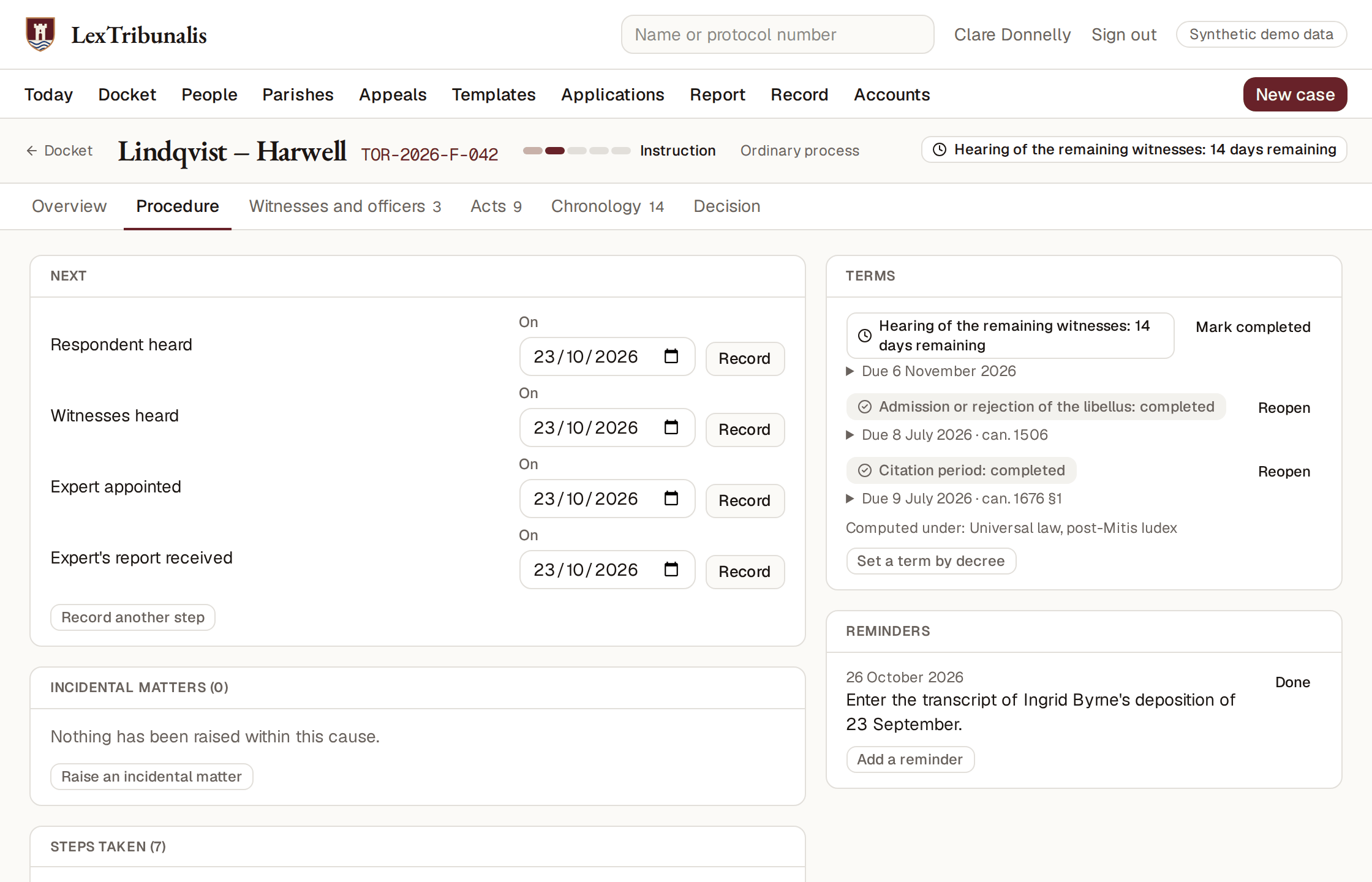
The procedure page offers the steps that can come next. Recording one moves the cause to its stage and opens the time limits that follow from it. Incidental matters are kept under the cause they arise in.
The ordinary, briefer and documentary processes are provided for, and a cause keeps the procedural law it was introduced under. The administrative procedures (lack of form, the Pauline privilege, the favour of the faith, ratum et non consummatum, presumed death) and the separation of spouses are in a first version that is still under review.
Time limits
Time limits (terms) are counted by the canons on the computation of time, cann. 200 to 203. One that would expire on a day the tribunal is closed runs to the next open day (can. 1467). Each shows the canon it rests on, and the judge can set one by decree.
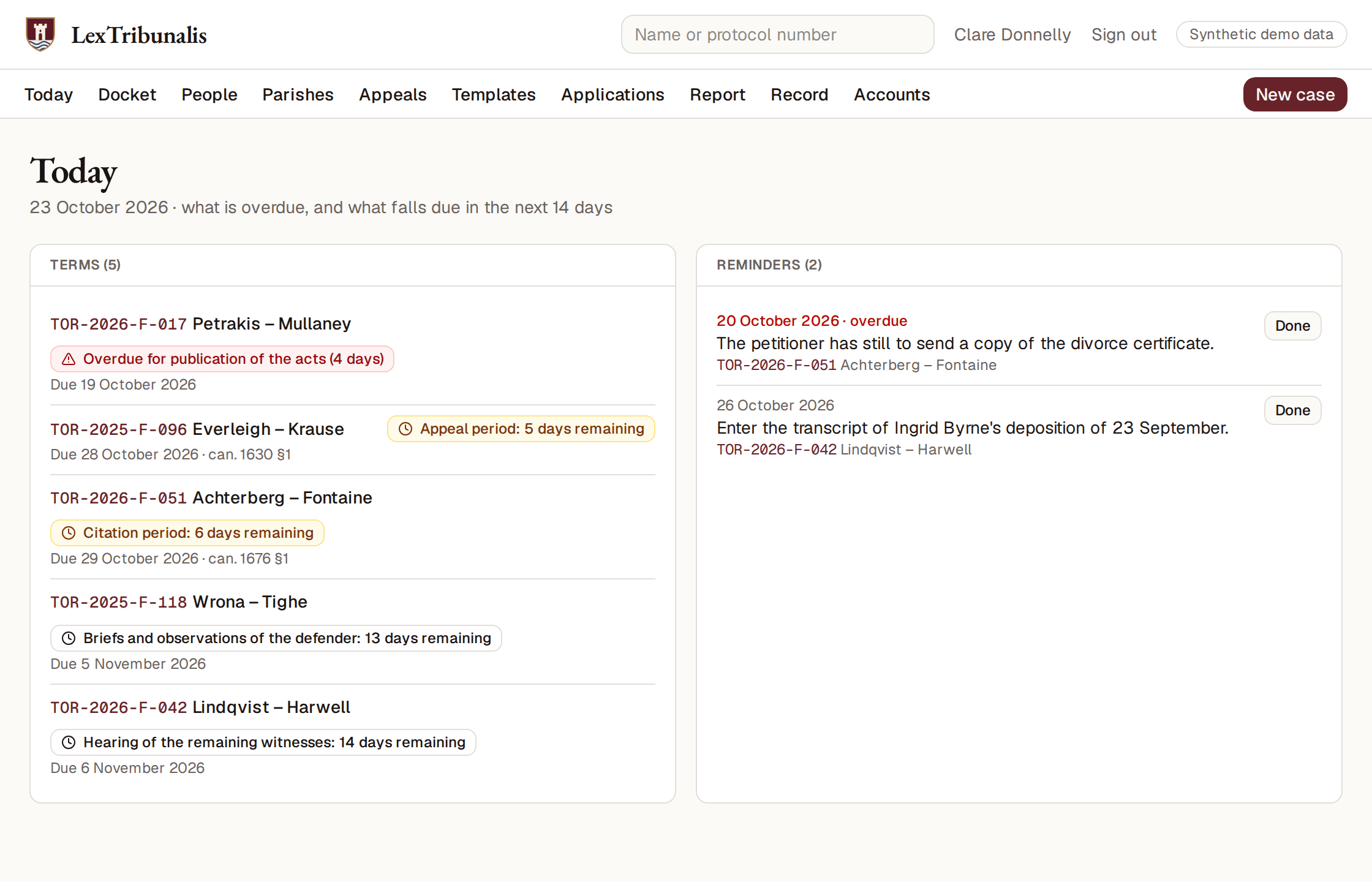
The Today page gathers what is overdue and what falls due in the next two weeks, together with reminders staff have left for themselves.
Time limits can also be written into each person's Outlook calendar, or read from a calendar address. A calendar entry carries the protocol number and the kind of time limit, and no name.
Letters and decrees from your own templates
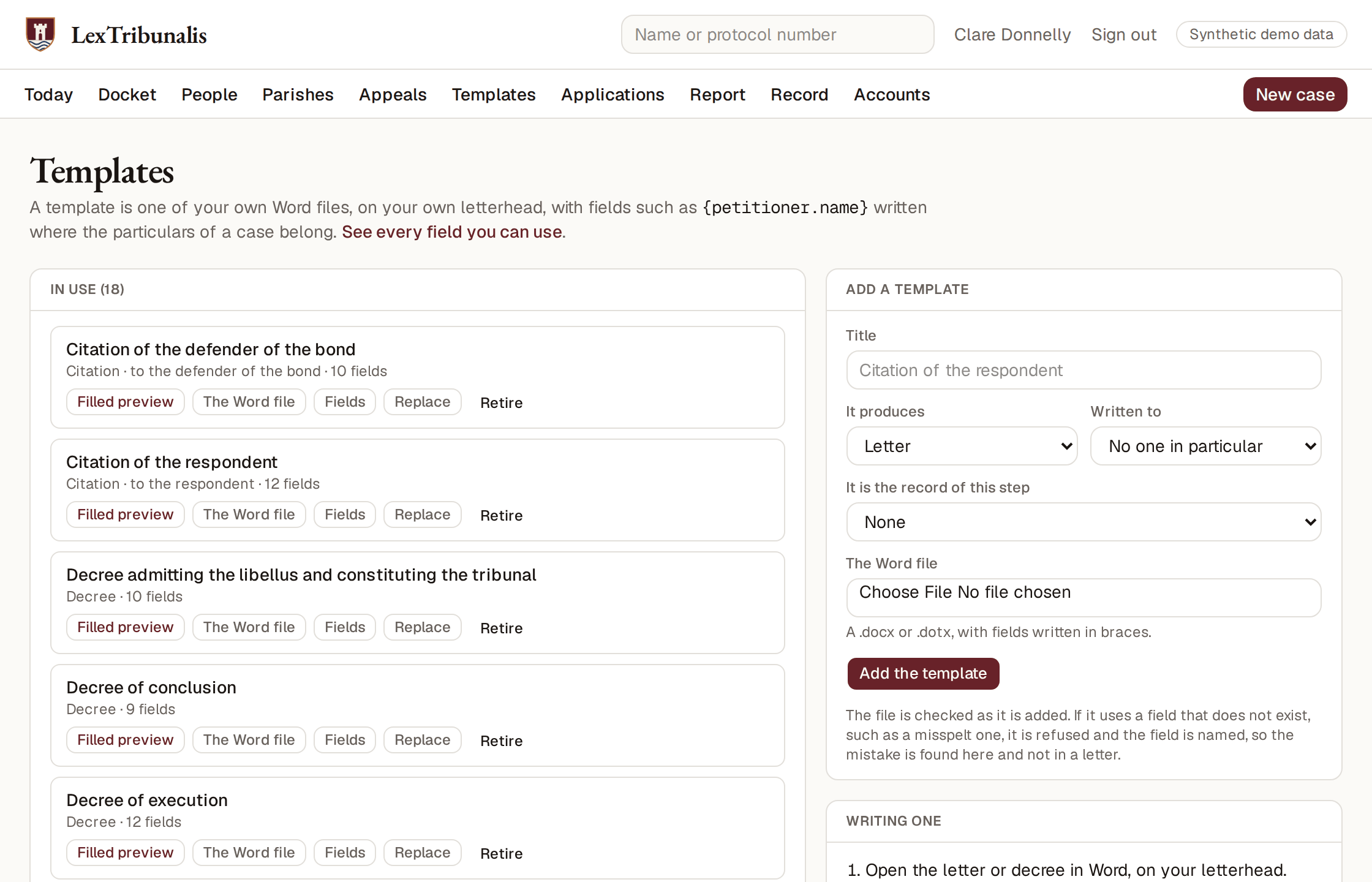
A template is one of the tribunal's own Word files. Wherever a particular of the cause belongs, such as the respondent's name, a field is typed in its place. Staff add, replace and retire templates themselves, and say which step of the process each one records.
A template is checked as it is added. If it uses a field that does not exist, such as a misspelt one, it is refused and the field is named, so the mistake is found then and not in a letter. The page lists every field that can be used.
What is made from a template is an ordinary Word file, filed in the acts, which can still be corrected before it is printed.
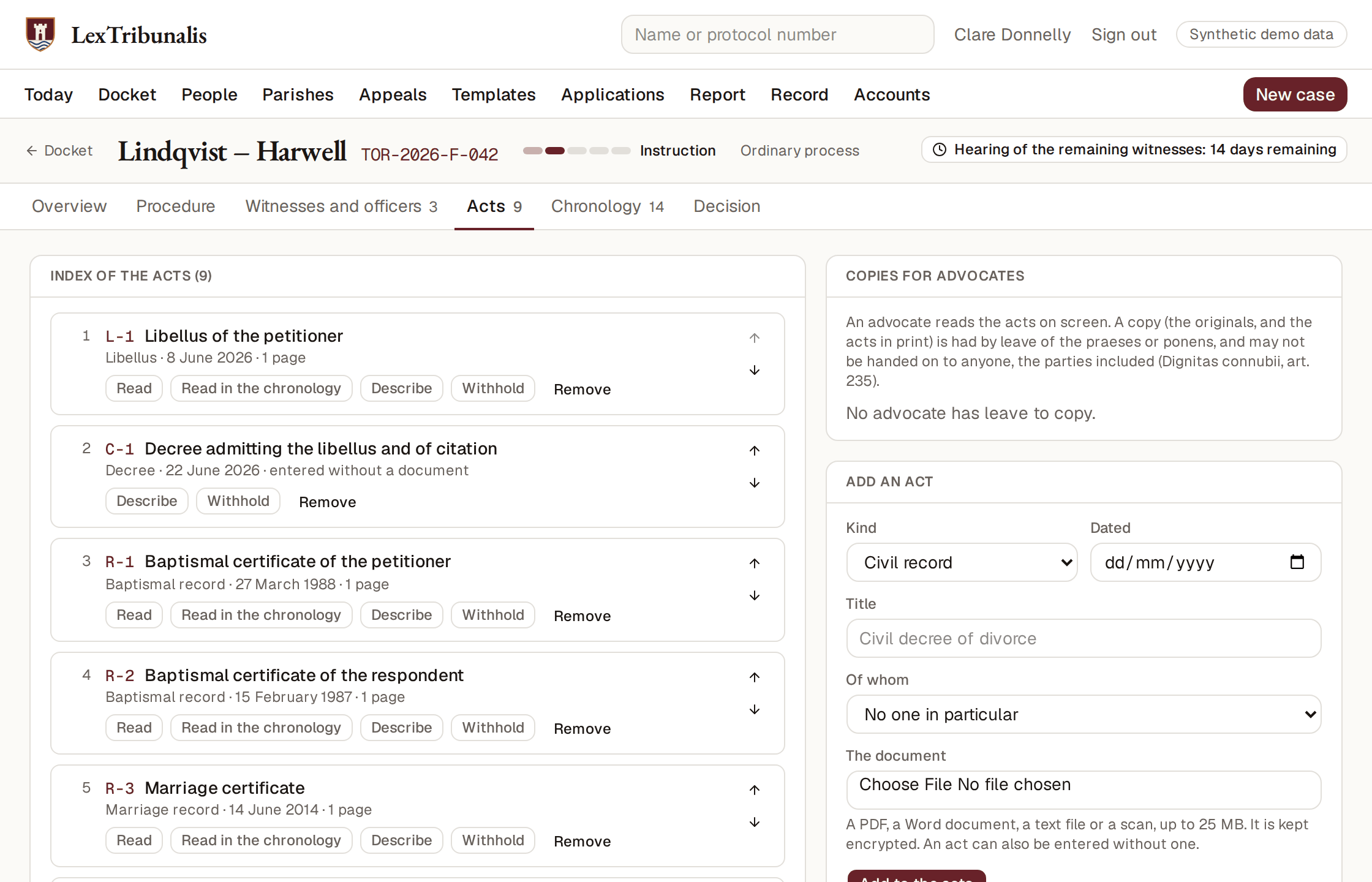
The acts
The index of everything in the file, in order, each act with its original document where there is one. Originals are stored encrypted.
A decree can order an act, some of its pages or a single passage withheld, and what is withheld is marked wherever it would appear. An advocate reads the acts on screen, and is given a copy only with the permission of the praeses or ponens.
The whole of the acts can be made into one numbered set, as a PDF: an index, then every act in order, each page numbered through. It can end with a page for the notary to sign and seal, headed Concordat cum originali or in the tribunal's own words, and it carries a seal by which a set in hand can be matched to the one the tribunal made. A votum is never in it.
A judge, defender of the bond or auditor can print that set for a cause they serve in, to read on paper with a pen in hand. Every page of such a copy says whose it is, and that it was made is recorded. A tribunal that prefers one hand on every paper copy can have the notary alone print: the others ask, and she is told.
From an act, a fact can be entered in the chronology of the cause by selecting the passage that states it. This is done by hand. The planned assistant would propose such entries for a person to decide on.
The annual reports
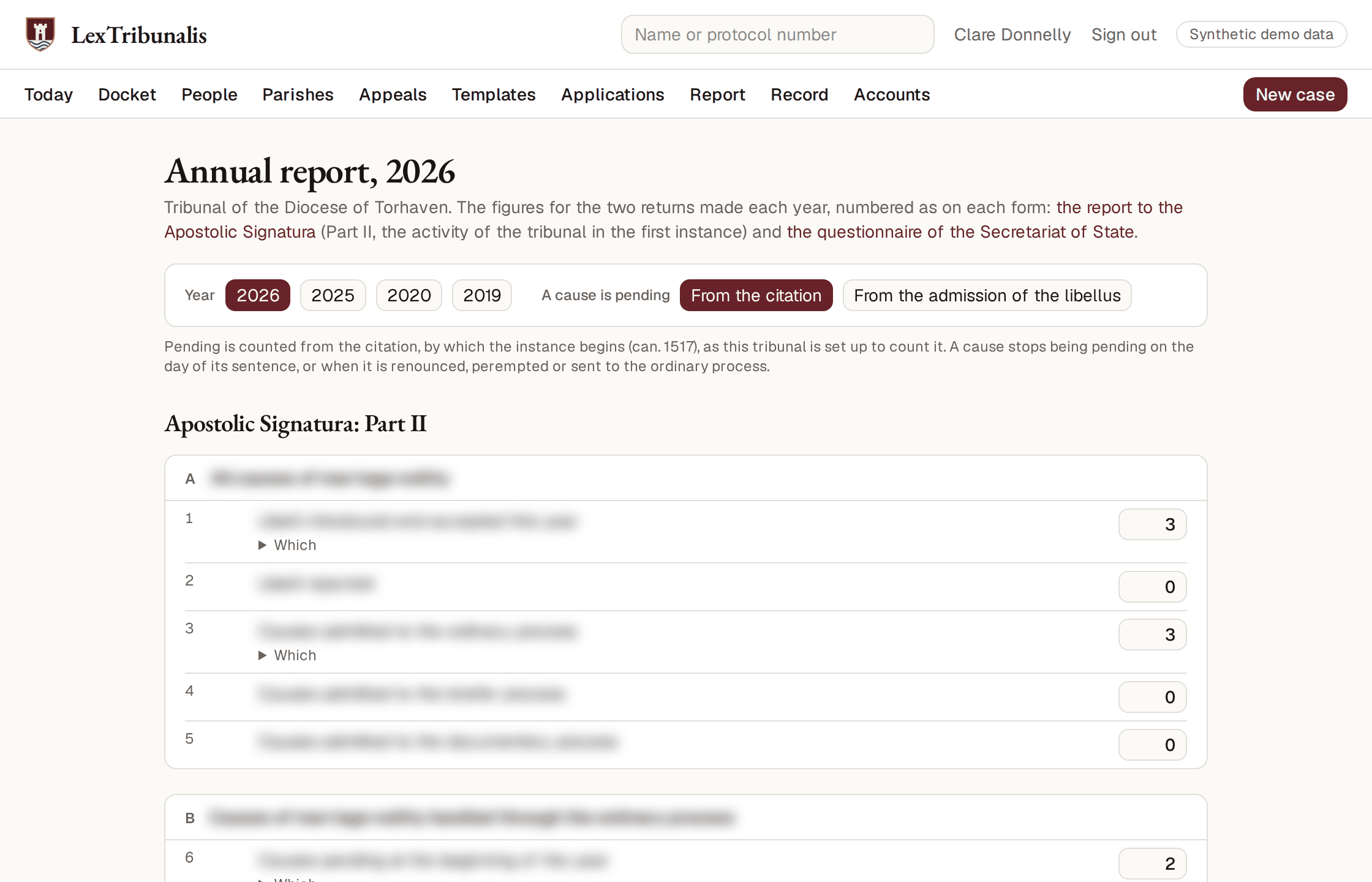
The figures for the report to the Apostolic Signatura and for the questionnaire of the Secretariat of State, numbered as on each form and counted from the record for any year.
Every figure can be opened to list the causes it counts. The count of pending causes can be made from the citation or from the admission of the libellus, whichever the tribunal's practice has been.
The report is shown to the Judicial Vicar and to nobody else, the administrator included, unless a tribunal chooses to open it to its own staff.
Accounts and the record of changes
Each person signs in with a password and a code from an authenticator app. An account belongs to a role, and an account for someone engaged in particular causes opens only those. Only the judges of a cause can read its vota, and no count of the votes is kept anywhere.
When a sentence is appealed, each judge is asked whether their votum is to go with the acts. It goes only if the judge wishes and the Judicial Vicar authorises it, and then without the judge's name.
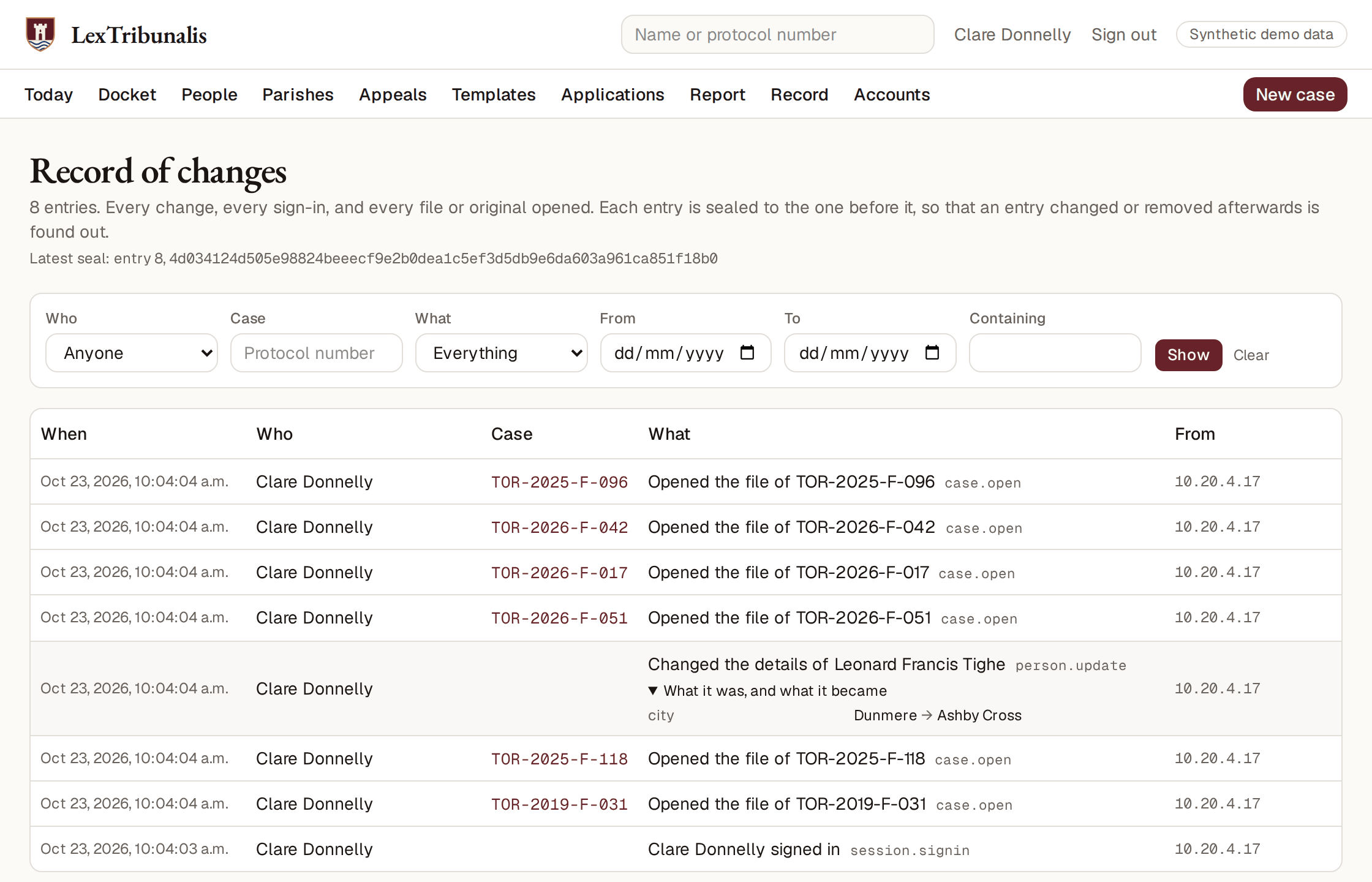
Every change, every sign-in and every document opened is recorded with who did it and when. For a change to a record, the entry shows what each field was and what it became. Removing something is recorded like any other change.
The record is a chain. Each entry is numbered and sealed with a hash of itself and of the entry before it, so that an entry changed, removed or slipped in afterwards is found out when the record is checked. The page shows the latest seal, which the notary can print and sign from time to time.
If two people change the same record at once, the second is told so and nothing is overwritten.
What else is included, and what is not yet
Also included
- The decision: the answer on each ground, any vetitum attached, and whether the decision is executive, with the reasoning shown.
- Appeals, with the dates the acts went and came back and the answer on each ground.
- One record for each person and each parish, however many causes they appear in.
- A way for a party to follow the progress of the cause, and for a witness to read over a deposition, ask for corrections and sign it, by a link and a code. Neither needs an account.
- Giving a party, one document at a time, what the law makes known to them: the citation, a decree, the sentence. They read it on screen and, where the tribunal allows, keep a copy. No deposition or other proof is given this way. Those are read at the tribunal when the acts are published.
- A register of rogatory requests, sent and received. Each is brought up to be asked after every three months until it is answered.
- Fees: what is asked towards costs, in instalments if wished, and what has been received. It is a record only. No payment is taken through the system and no card number is kept. The judges of a cause are shown none of it.
- An application form for the diocese's own website. It makes a file that the applicant sends to the tribunal, and nothing on the website connects to the system. Someone at the tribunal reads each answer and keeps it, corrects it or leaves it out before a cause is opened.
Not yet
- Bringing in the records of an existing system. This is the next thing to be built, with the first tribunal.
- Hearing a cause as the tribunal of second instance.
- Languages other than English.
- The deposition assistant, which is planned.
See it working
A demonstration is given by video call. Write to richard@lextribunalis.com, or use the form.